
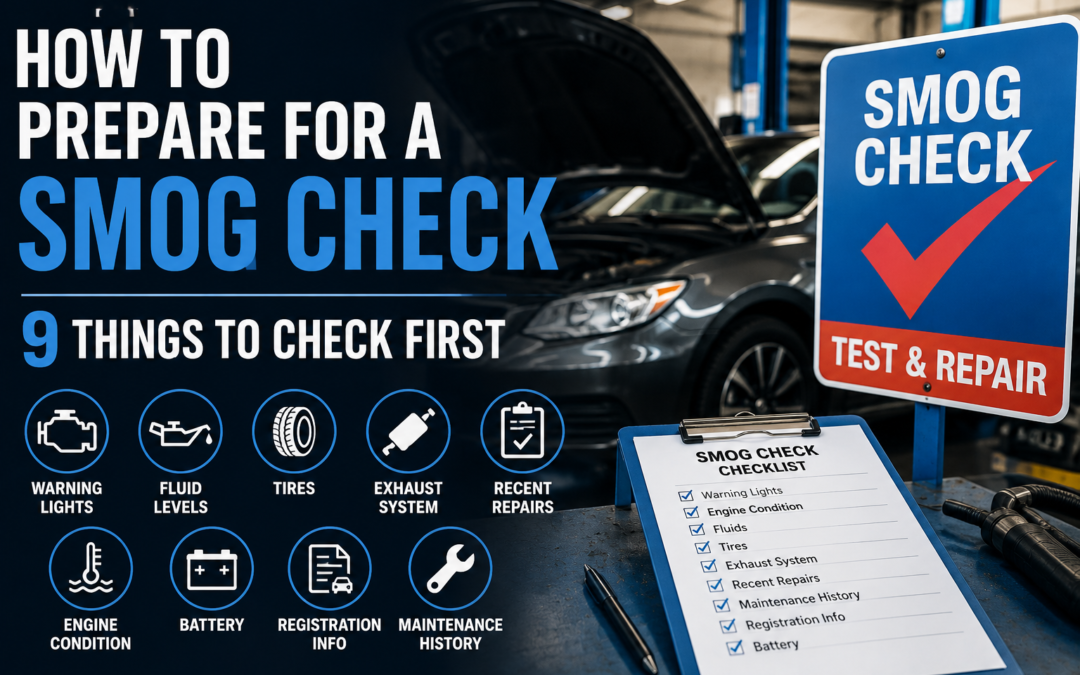
Getting ready for a smog check is about more than simply showing up for your appointment. A few basic checks beforehand can help you identify maintenance issues, address warning signs, and give yourself enough time to make necessary repairs before a testing deadline. While preparation can’t guarantee that your vehicle will pass, it can help you avoid preventable surprises.
California’s Smog Check Program is intended to identify vehicles with excessive emissions and help reduce air pollution. Requirements vary based on factors such as the vehicle and its registration circumstances, so it’s important to confirm the current requirements that apply to your vehicle before scheduling an emissions test.
This guide covers nine things to check before a smog inspection, from dashboard warning lights and engine condition to fluid levels, tires, and recent repairs. If you’re preparing for a smog check in Ventura, CA, these steps can help you get your vehicle ready for testing.
What Is a Smog Check?
A smog check is an emissions inspection required for certain vehicles in California. The program is administered by the California Bureau of Automotive Repair and is intended to identify vehicles that produce excessive emissions.
Depending on the vehicle, a California smog check can involve checking the vehicle’s emissions control systems and using equipment to measure or evaluate emissions-related performance. Modern vehicles may also undergo an inspection of their onboard diagnostic system.
A smog test is different from a general mechanical inspection. Passing a smog check doesn’t necessarily mean every component of your vehicle is in perfect condition, just as a mechanical issue doesn’t automatically mean your vehicle will fail an emissions test.
Who Needs a Smog Check in California?
Not every vehicle is subject to the same smog check requirements in California. Testing requirements can depend on factors such as the vehicle’s model year, fuel type, registration circumstances, and other state requirements.
Some vehicles and situations may qualify for exemptions, while others require testing during registration renewal or when ownership changes. Since California regulations can change, check the current requirements for your specific vehicle before your appointment.
Why Prepare Before a Smog Inspection?
Preparing your vehicle ahead of time gives you an opportunity to identify problems that could affect its emissions performance. A warning light, rough-running engine, or unresolved repair issue may indicate that your vehicle needs attention before testing.
Preparing early can help you:
- Identify potential problems before the appointment
- Allow time for necessary auto repair
- Keep up with routine auto maintenance
- Avoid rushing to meet a registration deadline
- Reduce the likelihood of unexpected delays
It’s important to remember that there are no legitimate shortcuts that can guarantee a passing result. The best approach is to keep your vehicle properly maintained and address known problems before the smog check.
1. Check Your Dashboard Warning Lights
Start your preparation by checking the dashboard. If the check engine light is illuminated, don’t ignore it simply because your vehicle still seems to drive normally.
A warning light can indicate a problem with an engine or emissions-related component. Continuing to drive without diagnosing the issue may allow a relatively minor problem to become more expensive.
Look for:
- Check engine light
- Emissions-related warning indicators
- Engine temperature warnings
- Other persistent dashboard alerts
An illuminated check engine light doesn’t tell you exactly what’s wrong. A professional diagnostic check is needed to identify the underlying issue and determine whether repairs are necessary before your smog test.
If your vehicle has recently developed warning lights, unusual noises, poor acceleration, or other changes in performance, addressing them before your appointment is a smart maintenance step. Our guide on Top Signs Your Car Needs Immediate Repair (Don’t Ignore These Warning Signs) covers symptoms that shouldn’t be overlooked.
Don’t attempt to clear a warning light simply to get through an emissions inspection. Clearing diagnostic codes can affect emissions monitor readiness, and the underlying problem may still be present. Proper diagnosis and repair are the better approach when preparing your vehicle for a smog check.
2. Inspect Your Engine and Emissions System
Your engine’s condition can have a direct impact on emissions performance. An engine that isn’t operating efficiently may produce higher emissions or trigger diagnostic trouble codes that can affect the outcome of a smog check.
Before your appointment, pay attention to changes such as rough idling, hesitation during acceleration, reduced fuel economy, or unusual exhaust smoke. These symptoms don’t automatically mean your vehicle will fail an emissions test, but they can indicate an underlying problem that should be diagnosed.
Several components contribute to your vehicle’s emissions control system, including:
- Oxygen sensors
- Catalytic converter
- Exhaust gas recirculation (EGR) system
- Evaporative emissions (EVAP) system
- Fuel and air delivery components
- Exhaust system components
These systems work together to control and reduce emissions. If a component isn’t functioning correctly, professional auto repair may be necessary before your smog check in Ventura.
Don’t replace emissions components based solely on a symptom or assumption. Proper diagnostics can help identify the actual cause of a problem and prevent unnecessary repairs.
3. Check Your Engine Oil
Engine oil doesn’t directly determine whether your vehicle passes every part of a smog test, but keeping up with oil changes is an important part of overall vehicle maintenance.
Old or contaminated oil can affect engine performance over time. Check the oil level according to your vehicle manufacturer’s instructions and make sure you’re following the recommended oil-change schedule.
Before your smog inspection, look for:
- Low oil level
- Extremely dirty oil
- Oil leaks
- Unusual engine noises
- An illuminated oil warning light
If your vehicle is due for an oil change, completing the service as part of your regular auto maintenance routine can help keep the engine operating properly.
For more information about checking and maintaining essential vehicle fluids, see The Complete Guide to Vehicle Fluid Checks and Replacements.
4. Check Your Fluid Levels
Your vehicle depends on several fluids to maintain proper operation. Checking fluid levels before a smog check allows you to catch leaks or other maintenance issues that may need attention. Check the fluids that your vehicle is equipped with, including:
- Coolant
- Transmission fluid
- Brake fluid
- Power steering fluid
- Engine oil
- Windshield washer fluid
Pay particular attention to coolant. An engine that is overheating or running outside its normal temperature range needs to be inspected before you continue driving it.
Also look underneath your vehicle for signs of fluid leaks. Repeatedly adding fluid without finding the source of a leak can allow the underlying problem to worsen.
Remember that not every fluid needs to be checked or replaced at the same interval. Your owner’s manual provides the appropriate recommendations for your vehicle. You can also have a professional technician inspect the fluid levels and condition during routine auto maintenance.
5. Inspect Your Tires
Your tires aren’t directly tested as part of the vehicle’s emissions performance, but they should still be in good condition before any routine vehicle service or inspection.
Start by checking that all four tires have the correct air pressure. The recommended pressure can usually be found on the driver’s doorjamb label or in your owner’s manual.
Also look for:
- Uneven tread wear
- Low tread depth
- Cracks or bulges
- Cuts or punctures
- Objects embedded in the tread
Uneven wear can sometimes indicate an alignment, suspension, or tire-pressure problem. If you notice that one side of a tire is wearing significantly faster than the other, have it inspected rather than simply replacing the tire.
Our guide on How to Know When It’s Time for New Tires covers the warning signs that indicate your tires may be approaching the end of their usable life.
Keeping your tires properly maintained won’t guarantee a passing smog check, but it contributes to overall vehicle safety and gives you an opportunity to address other maintenance concerns before your appointment.
7. Address Recent Repairs and Maintenance Issues
If your vehicle has recently had engine or emissions-related repairs, make sure the repairs have been properly completed before scheduling a smog check in Ventura. Simply replacing a component or clearing a warning light doesn’t necessarily mean the vehicle is ready for an emissions test.
Modern vehicles use onboard diagnostic systems to monitor emissions-related components. After certain repairs, the vehicle may need to be driven under specific conditions before all required emissions monitors are ready. If the monitors haven’t completed their checks, your vehicle may not be ready for testing.
This is especially important if you recently:
- Replaced the battery
- Had the check engine light diagnosed
- Repaired an emissions-related component
- Cleared diagnostic trouble codes
- Had significant engine or exhaust work performed
If you’re unsure whether your vehicle is ready, have it professionally checked before your appointment. A technician can help determine if additional diagnostic work or drive time is needed.
Keeping up with your vehicle’s maintenance can also help you identify potential problems before they interfere with your smog check.
8. Check Your Vehicle’s Maintenance and Registration Information
Before heading to your smog inspection, make sure you have the information you may need for the appointment. Having everything ready can make the process easier and help prevent avoidable delays.
Check that you have:
- Current vehicle registration information
- Vehicle Identification Number (VIN)
- License plate information
- Smog check notice, if applicable
- Previous inspection information, if available
- Documentation related to recent repairs, when relevant
Your specific requirements may vary depending on your vehicle and circumstances, so confirm what you need before your appointment.
It’s also worth reviewing your vehicle’s maintenance history. If you’ve recently noticed a warning light, unusual engine behavior, or reduced performance but haven’t had the problem diagnosed, consider taking care of it before the smog test rather than waiting for the inspection to reveal an issue.
9. Schedule Your Smog Check Before the Deadline
Don’t wait until the last possible day to schedule your smog check. Giving yourself enough time before a registration deadline allows you to deal with potential repairs if your vehicle doesn’t pass the first time.
Scheduling early gives you time to:
- Have the vehicle professionally inspected
- Complete necessary repairs
- Address emissions-related problems
- Confirm diagnostic monitors are ready when applicable
- Complete a required retest if necessary
This can be particularly helpful for drivers looking for a smog check in Ventura who rely on their vehicle for work, commuting, or daily errands.
What to Expect During a Smog Check
The exact testing process depends on your vehicle and the applicable California requirements. Generally, the testing facility will verify vehicle information and perform the emissions-related inspections or tests required for that vehicle.
Modern vehicles may undergo an OBD inspection, which checks the vehicle’s onboard diagnostic system and emissions-related monitors. Older vehicles may be subject to different testing procedures.
The technician will provide the test results once the inspection is complete. If the vehicle passes, you’ll receive the appropriate documentation for your registration requirements. If it fails, the results should identify the areas requiring further diagnosis or repair.
What If Your Car Fails a Smog Check?
A failed smog check doesn’t necessarily mean your vehicle needs major repairs. The appropriate next step is to review the failure information and have the problem properly diagnosed.
Avoid replacing expensive components based only on assumptions. A professional diagnosis can determine whether the issue involves a sensor, emissions component, engine problem, or another cause.
Once the necessary repairs have been completed, your vehicle may need to undergo another smog inspection. Addressing the underlying problem rather than simply attempting to clear warning lights gives you a better path toward resolving the issue.
If your vehicle does fail, our guide What to Do If Your Car Fails a Smog Check provides additional information about the next steps.
Smog Check Preparation Checklist
Preparing for a smog check doesn’t have to be complicated. A little attention to your vehicle before the appointment can help you identify potential issues early and give you enough time to address problems before your testing deadline.
Use this checklist before your smog inspection:
| What to Check | What to Look For |
| Dashboard warning lights | Check engine or other persistent warning lights |
| Engine condition | Rough idling, hesitation, unusual noises, or performance changes |
| Emissions system | Signs of emissions-related problems or recent repairs |
| Engine oil | Proper level and overdue maintenance |
| Fluid levels | Low levels, contamination, or visible leaks |
| Tires | Proper inflation, tread condition, and visible damage |
| Exhaust system | Unusual smoke, odors, or visible damage |
| Maintenance history | Recent or overdue service |
| Registration information | Current documents and applicable testing requirements |
Keep in mind that these checks don’t guarantee a passing smog test. They simply give you an opportunity to address known problems before the inspection.
Get Ready for Your Smog Check in Ventura
A smog check is easier to manage when you prepare ahead of time. Checking warning lights, maintaining your engine and fluids, addressing known problems, and scheduling your inspection before your deadline can help you avoid unnecessary delays.
If you’re looking for a smog check Ventura drivers can rely on, Advanced Auto Care & Smog provides professional Smog Check, Auto Maintenance, and Auto Repair services. If your vehicle needs attention before testing, having the problem properly diagnosed can help you understand what repairs are actually necessary.
Don’t wait until a registration deadline is approaching. Schedule your Smog Check with Advanced Auto Care & Smog and give yourself time to address any issues that may arise.
Frequently Asked Questions
1. How should I prepare my car for a smog check?
Check for dashboard warning lights, inspect your fluids and tires, address known engine or emissions problems, and make sure any recent repairs have been completed properly before your appointment.
2. What should I check before a smog inspection?
Check your check engine light, engine condition, fluid levels, tires, exhaust system, maintenance history, and any recent repairs that could affect emissions-related systems.
3. Can a check engine light cause a smog check failure?
An illuminated check engine light can indicate an emissions-related problem and may affect the outcome of an emissions inspection. Have the underlying issue diagnosed rather than simply clearing the warning light.
4. Does an oil change help you pass a smog check?
An oil change is an important part of routine vehicle maintenance, but it does not guarantee that your vehicle will pass a smog check. Emissions-related systems and other factors are evaluated during testing.
5. Can regular maintenance help with a smog check?
Regular Auto Maintenance can help identify and address mechanical or emissions-related problems before they become more serious. Proper maintenance also supports overall vehicle performance.
6. What causes a car to fail a smog check?
A vehicle can fail for several reasons, including emissions-related component problems, diagnostic trouble codes, or emissions system issues. The exact cause depends on the vehicle and test results.
7. What happens if my car fails a smog check?
Review the test results and have the vehicle properly diagnosed. Once the underlying issue is repaired, you may need to complete another smog inspection.
8. How often do you need a smog check in California?
The frequency depends on the vehicle and its registration circumstances. California requirements can vary, so check the current requirements that apply to your specific vehicle.
9. Where can I get a smog check in Ventura?
Advanced Auto Care & Smog provides Smog Check services in Ventura along with Auto Repair and Auto Maintenance to help drivers address vehicle issues and stay on top of routine care.
10. Can I get repairs done if my vehicle fails a smog check?
Yes. If your vehicle fails a smog check, the next step is to identify the cause of the failure. Professional diagnostics can determine what needs to be repaired, whether it’s an emissions component, an engine issue, or another problem. Once the necessary repairs are completed, the vehicle can be retested.